Texas weather in 2026 throws hail alley conditions in the north, hurricane-force gusts on the Gulf Coast, and 100-plus degree sun everywhere in between at every metal roof — the style you pick decides whether that roof lasts 10 years or 40.
- Standing seam metal roofs win for hail-prone Texas regions in 2026 — concealed fasteners and Class 4 impact ratings cut leak risk.
- Vertical roof (A-frame) panels shed rain and debris faster than boxed eave roofs, the top pick for high-rainfall counties.
- Boxed eave (regular) roofs cost less in labor but need more sealant maintenance in freeze-thaw cycles.
- R-panel roofs cover wide spans fast, the base choice for large commercial and agricultural buildings.
- Continuous multi-span roofs handle the wider open spans barndominiums need for combined living and garage space.
Why this matters
Texas is not one climate. The Panhandle sits in hail alley, the Gulf Coast takes hurricane-strength gusts, and East Texas gets rainfall totals that flatter roof pitches struggle to clear. A roof style built for a barn near Amarillo will not hold up the same way on a carport near Houston.
Texas Metal Structures designs and builds roofs matched to the wind, hail, and rain load of the specific county the building sits in — not a single panel style stamped out for every job.
Best overall: standing seam metal roof. Best for heavy rainfall: vertical roof (A-frame). Best budget option: regular (boxed eave) roof. Best for large spans: R-panel roof. Best for barndominiums: continuous multi-span roof.
What makes the best metal building roof style for Texas weather
- Wind uplift rating — resistance to the gusts common on the Gulf Coast and across the Panhandle
- Hail impact rating — a UL 2218 Class 4 rating on the panel itself matters more in hail alley counties
- Roof pitch and drainage — steeper pitch clears water and debris faster during East Texas downpours
- Fastener exposure — concealed fasteners resist wind-driven rain better than exposed screw patterns over decades
- Steel gauge and coating — thicker gauge steel with a Galvalume or PVDF finish resists rust and UV fade
- Span capability — determines how wide a building can go without interior support columns
Metal building roof styles at a glance
| Roof style | Best for | Standout feature | Key limitation |
|---|---|---|---|
| Standing seam metal roof | Hail-prone regions | Concealed fasteners, Class 4 rating | Higher install complexity |
| Vertical roof (A-frame) | High-rainfall counties | Steep pitch sheds water fast | Uses more panel material |
| Regular roof (boxed eave) | Tight-budget carports | Lower labor cost, classic profile | Exposed fasteners need resealing |
| R-panel roof | Large commercial/ag buildings | Wide coverage, fast install | Lower pitch slows drainage |
| Continuous multi-span roof | Barndominiums | Spans wide open floor plans | Needs engineered trusses |
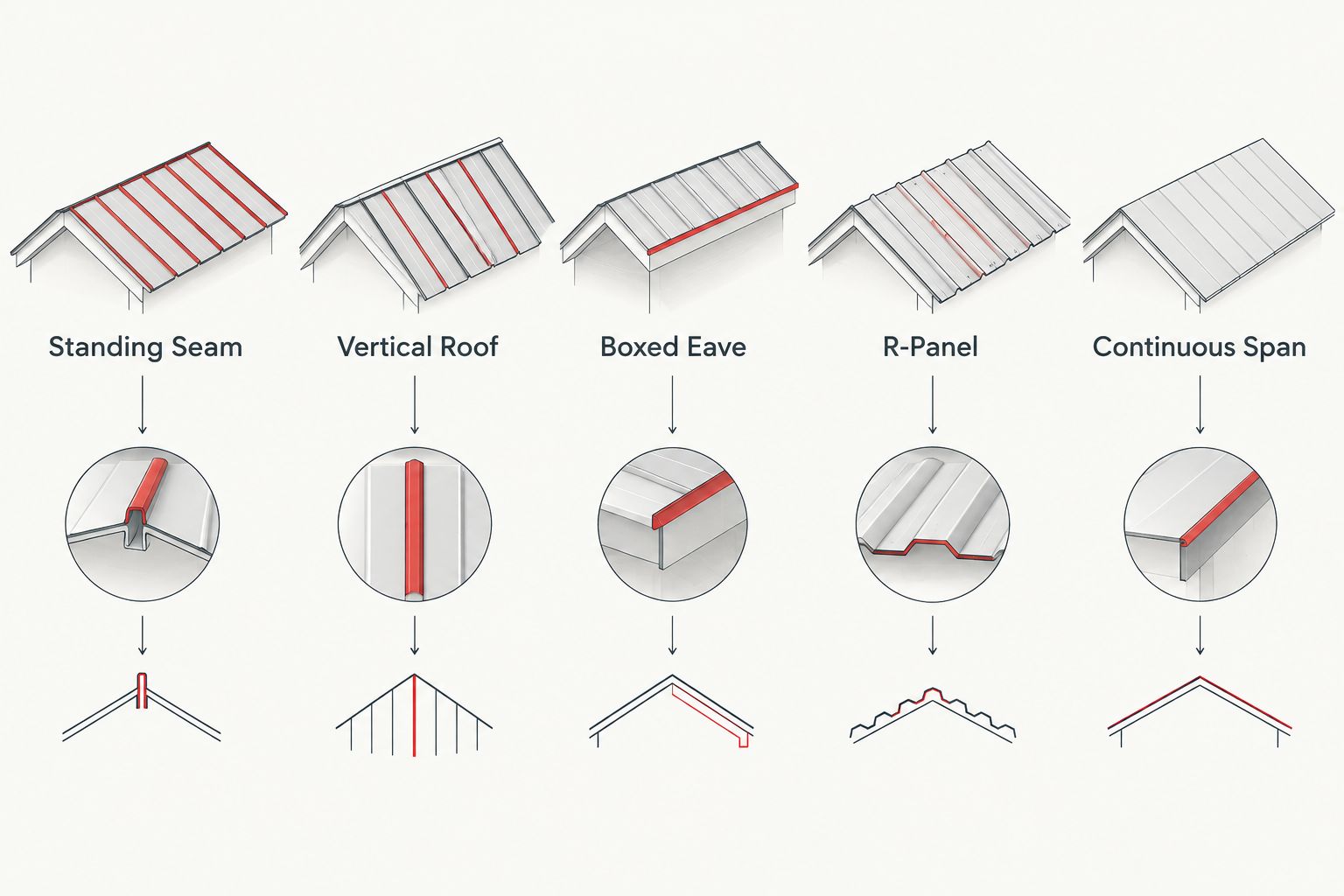
1. Standing Seam Metal Roof: best metal building roof for hail-prone regions
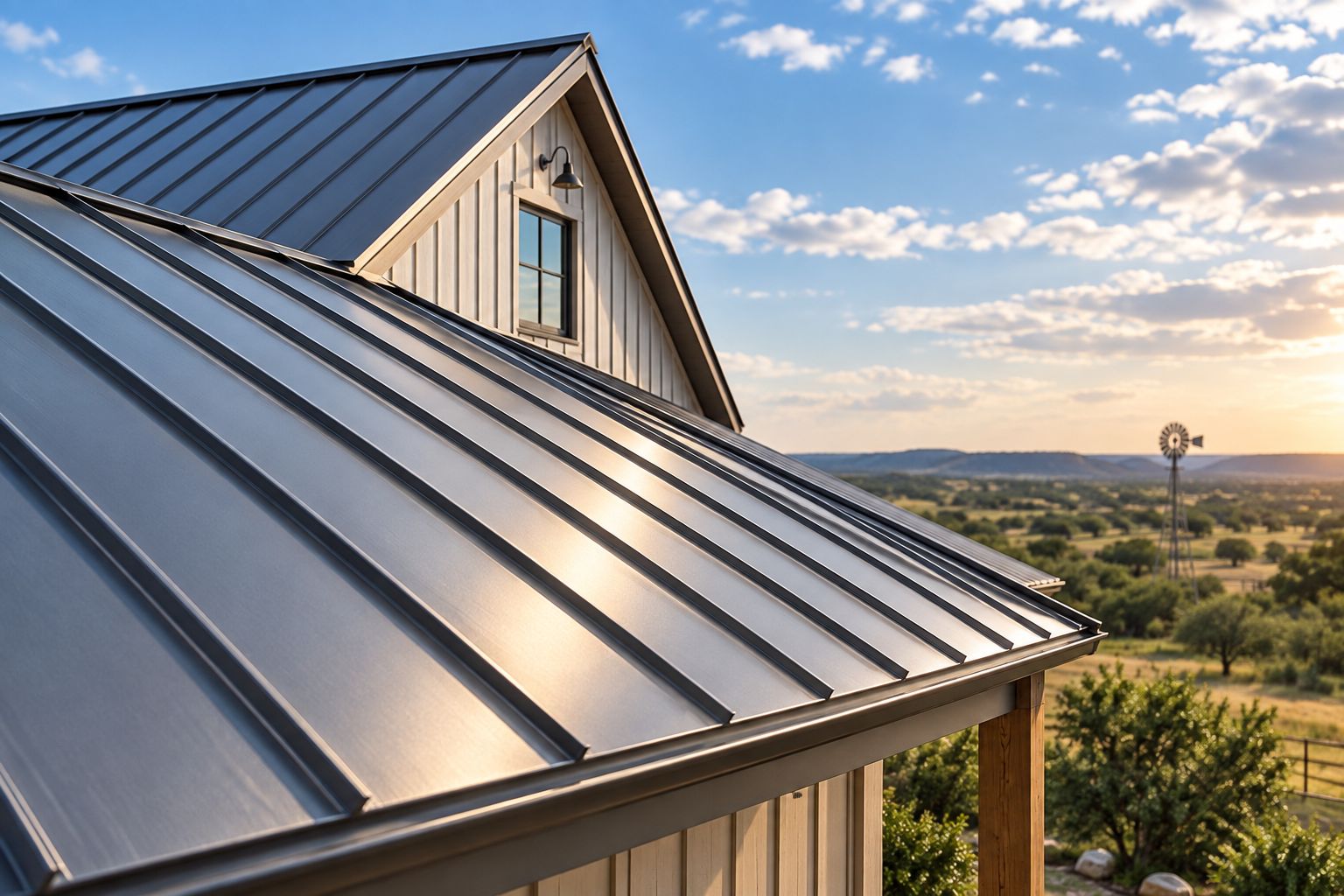
Standing seam panels interlock along raised vertical seams, with fasteners hidden underneath the panel rather than exposed to weather. Most standing seam systems on Texas builds run 24 to 26-gauge steel and can be finished to meet a UL 2218 Class 4 hail impact rating.
Standing seam pros:
- Concealed fasteners cut the leak points that wind-driven rain finds fastest
- Class 4 hail-rated panels commonly qualify for insurance premium consideration
- PVDF-coated finishes resist fading under Texas sun far longer than uncoated steel
- Works on both low-slope commercial roofs and steep barndominium rooflines
Standing seam cons:
- Costs more to fabricate and install than a boxed eave roof of the same footprint
- Overkill on a covered carport in a low-hail interior county
Best for: hail-prone counties across North and Central Texas. Verdict: Buy for any build sitting inside hail alley.
2. Vertical Roof (A-Frame): best metal building roof for high-rainfall counties
A vertical roof runs steep-pitch panels top to bottom in a peaked A-frame shape, the most common profile on Texas carports and barns. The steep pitch clears rain and leaf debris far faster than a flatter boxed eave roof of the same size.
Vertical roof pros:
- Steep pitch reduces standing water and ponding risk during East Texas downpours
- Simpler to fabricate than standing seam while still shedding water fast
- Works with either exposed or concealed fastener panels
- Familiar profile that matches most residential zoning expectations
Vertical roof cons:
- Taller profile exposes more surface area to crosswind
- Uses more panel material than a boxed eave roof covering the same footprint
Best for: East Texas and Gulf Coast interior counties with heavy annual rainfall. Verdict: Buy for rain-heavy sites.
3. Regular Roof (Boxed Eave): best metal building roof for tight-budget carports
A boxed eave roof, sometimes called a regular roof, uses a lower-profile arched or gently sloped shape with a boxed trim at the eave. It is the traditional shape for detached carports and utility buildings across Texas.
Boxed eave pros:
- Lower labor and material footprint than vertical or standing seam roofs
- Faster build time on a standard carport or storage building
- Familiar look that blends into most residential neighborhoods
Boxed eave cons:
- Exposed fasteners loosen and need resealing as rubber washers age
- Shallower pitch holds water longer during heavy Texas storms
- Lower hail impact rating than standing seam in the same gauge
Best for: budget carports and utility sheds in milder wind zones. Verdict: Buy for budget builds; Skip in coastal high-wind counties.
4. R-Panel Roof: best metal building roof for large commercial and agricultural buildings
R-panel is a corrugated steel panel with wide rib spacing, the standard choice for large commercial buildings, warehouses, and agricultural structures where covering wide spans fast matters more than a steep pitch.
R-panel pros:
- Covers wide spans faster than standing seam or vertical panels
- Widely available in multiple gauge options for commercial and ag jobs
- Holds up on properly engineered low-slope commercial roofs
R-panel cons:
- Lower pitch slows drainage during heavy downpours
- Exposed fastener pattern needs inspection after a major hailstorm
Best for: large-footprint commercial and agricultural buildings. Verdict: Buy for big-span builds.
5. Continuous Multi-Span Roof: best metal building roof for barndominiums
A continuous multi-span roof uses engineered trusses to cover wide open interiors without interior support columns — the roof style barndominiums need to combine open living space and garage bays under one roofline.
Continuous multi-span pros:
- Clears wide spans needed for open floor plans without interior columns
- Single unified roofline simplifies flashing and gutter runs
- Can be finished in either standing seam or R-panel steel
Continuous multi-span cons:
- Requires engineered trusses, which adds design time before the build starts
- Not needed on a standard detached carport or small storage building
Best for: barndominiums and combined living/garage structures. Verdict: Buy for barndominium projects.
Get a roof style matched to your county
Talk through wind, hail, and pitch requirements before you order.
How we ranked
Each roof style is scored against the six criteria above: wind uplift rating, hail impact rating, drainage pitch, fastener exposure, steel gauge and coating, and span capability. Standing seam leads because it clears the top two criteria — hail rating and fastener exposure — that cost Texas homeowners the most in repair claims after storm season. Vertical roof, boxed eave, R-panel, and continuous multi-span each lead a different criterion instead of competing head-to-head for the same slot.
Which metal building roof style should you choose?
If the build sits anywhere between the Panhandle and Central Texas, hail is the dominant risk in 2026 — pick standing seam. If the site gets heavy annual rainfall in East Texas or along the Gulf interior, prioritize drainage speed — pick a vertical roof. A tight-budget detached carport in a mild wind zone still does fine on a boxed eave roof. A large commercial shop or ag building covering thousands of square feet gets built fastest on R-panel. A barndominium combining living space and garage bays needs the wider span only a continuous multi-span roof delivers.
FAQ
What is the best metal building roof style for Texas hail?
Standing seam metal roofing is the best choice for Texas hail because it can be finished to a UL 2218 Class 4 impact rating and hides fasteners under the panel instead of exposing them to hail strikes.
Is a vertical roof better than a boxed eave roof for rain?
Yes, for heavy rainfall a vertical (A-frame) roof clears water faster because of its steeper pitch, while a boxed eave roof's flatter profile holds standing water longer during downpours.
How much roof pitch does a metal building need in Texas?
Standing seam panels generally need a minimum 3:12 pitch to drain properly. R-panel systems can run on lower slopes when the framing is engineered for it.
Does roof style affect insurance rates on a metal building?
A Class 4 hail-rated panel, most commonly found on standing seam roofs, is often considered favorably by insurers writing wind and hail coverage in Texas. Check with your carrier for the exact terms.
What roof style works best for a barndominium?
A continuous multi-span roof is the best fit for a barndominium because it spans wide open living and garage areas under one roofline without interior support columns.
Can I mix roof panel styles on one metal building?
You can, but most Texas builds use one consistent panel style for the whole roof to keep flashing, gutter runs, and warranty coverage simple.
What gauge steel roof holds up best in Texas wind?
26-gauge steel or thicker is the standard recommendation for coastal and high-wind Texas counties, where gust loads are higher than inland regions.
How long does a metal building roof last in Texas weather?
A standing seam metal roof commonly lasts 40 to 70 years with proper coating, while boxed eave panels with exposed fasteners often need resealing every 10 to 15 years.
One last thing
The roof style that gets skipped most often in Texas quotes is R-panel on a residential barndominium — builders default to standing seam for the look, but a continuous multi-span R-panel roof handles the same wide-open floor plan at a lower fabrication complexity when the steep-pitch aesthetic isn't the priority. Match the pitch and fastener pattern to the actual weather risk on the site in 2026, not to the roof style shown in a brochure photo.