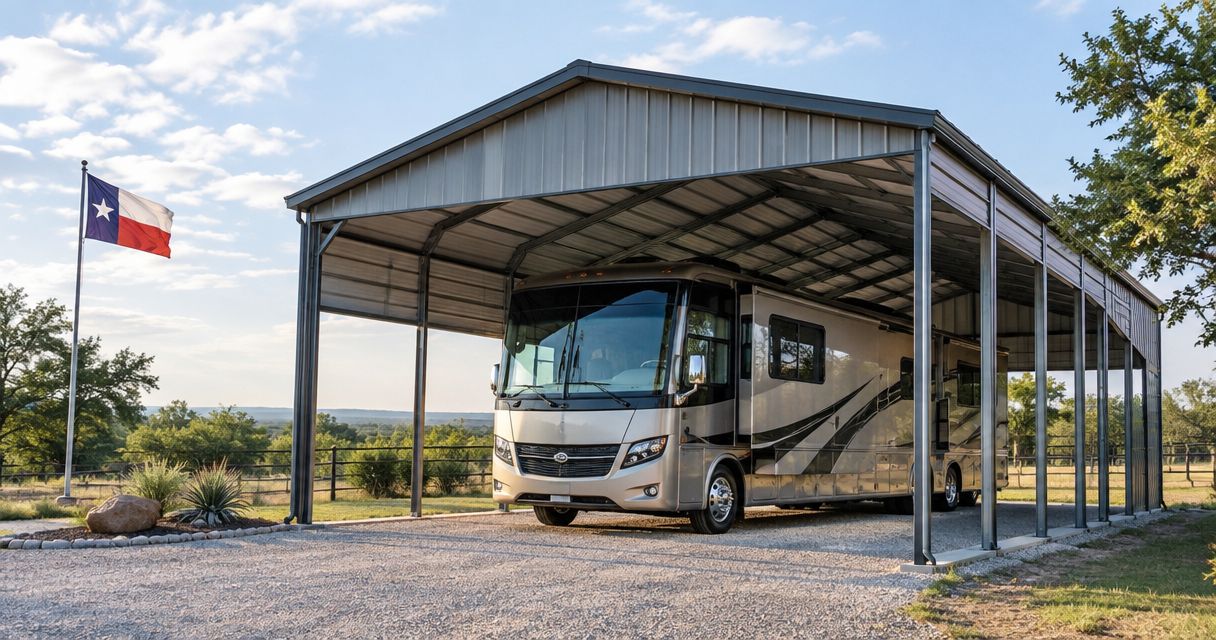
Texas RV owners lose more roof coatings and awning fabric to hail and UV than to any mechanical failure — the size and roof style of the carport you park under decides how much of that damage you avoid. Best overall for most Texas RV owners: the 12x31 metal carport with a vertical roof. Best for pop-up campers and small travel trailers: the 12x21. Best for Class A motorhomes and tall diesel pushers: the 14x36 with vertical roof panels.
- The 12x31 vertical-roof metal carport is the best overall pick among the best metal carport sizes for RV storage Texas owners buy in 2026.
- 12x21 fits pop-up campers and short travel trailers; 14x36 is required for full-size Class A motorhomes.
- Vertical roof panels shed Texas hail and heavy rain faster than A-frame panels on any size over 26 feet.
- Add 1-2 feet of leg height above your RV's actual height to clear roof AC units and antennas.
- 20x30 and larger sizes solve storage for households parking an RV next to a boat or second vehicle.
Why this matters
A carport sized wrong in either direction costs you twice. Too short in length and the trailer tongue or motorhome bumper sits exposed to sun and rain; too short in height and the AC unit or roof vent scrapes the crossbeam every time you pull in.
Texas adds two problems most carport buying guides ignore: hail large enough to dent a fiberglass RV roof, and wind gusts that hit 100+ mph during spring supercell season. A metal carport built for RV storage in 2026 needs to answer both, not just fit the RV's dimensions.
Texas Metal Structures builds carports across residential and commercial Texas properties, and the sizing pattern below reflects the units homeowners and RV storage operators actually order — not a generic size chart pulled from a national retailer.
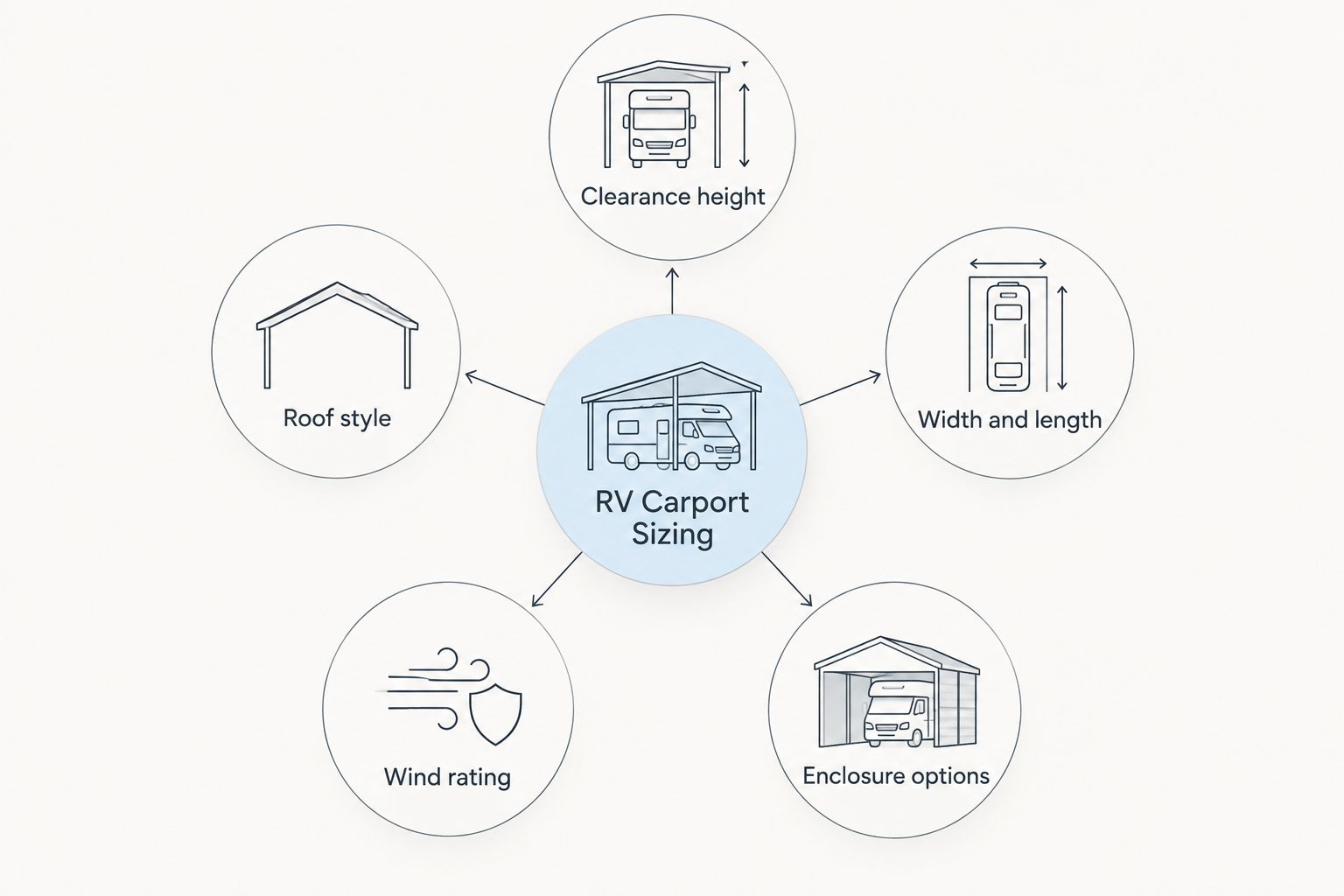
What makes the best metal carport for RV storage
- Clearance height — leg height has to clear the RV's roof-mounted AC unit and antenna, not just the body height.
- Roof style — vertical roof panels shed water and hail faster than horizontal A-frame panels on longer spans.
- Width and length matched to RV class — a fifth wheel's pin box and a Class A's slide-outs need different footprints than a travel trailer.
- Wind rating — Texas wind zones range from roughly 90 mph inland to 140 mph along the Gulf Coast; the certified rating has to match your county.
- Enclosure options — open-sided, partial-wall, and fully enclosed each trade cost of materials for weather protection.
- Permit and setback fit — larger footprints trigger HOA review and county permitting sooner than compact ones.
Metal carport sizes for RV storage: at a glance
| Size | Best for | Standout feature | Key limitation |
|---|---|---|---|
| 12x21 | Pop-up campers, small travel trailers | Smallest footprint, easiest permit | No room for a truck or fifth wheel |
| 12x26 | Mid-size travel trailers, truck campers | Fits the most common bumper-pull length | Tight for trailers with awning arms out |
| 12x31 vertical roof | Fifth wheels, Class C motorhomes | Best overall balance of length and clearance | Needs certified footings at this span |
| 14x36 vertical roof | Class A motorhomes, diesel pushers | 14 ft legs clear roof AC and satellite domes | Largest single-bay footprint, most permitting |
| 20x30 | RV plus boat or second vehicle | One roof over two recreational assets | Doesn't add leg height for taller RVs |
| 24x40+ enclosed | Commercial RV storage, full enclosure | Roll-up doors, full weather protection | Requires a real foundation, not piers |
1. 12x21 metal carport: best for pop-up campers and small travel trailers
A 12x21 bay covers a single towable unit up to about 20 feet with 6 to 8 foot legs. It's the smallest structure on this list and the easiest to fit on a standard residential driveway.
12x21 pros:
- Smallest footprint clears most HOA setback rules without variance
- Lowest steel tonnage of any size here, so it goes up fastest
- 8 ft legs clear most travel trailer roofs under 10 feet tall
12x21 cons:
- No side room for a truck to park alongside the trailer
- Doesn't clear fifth wheels or any motorhome
- Locks you out of an RV upgrade without rebuilding
12x21 best for: single-axle travel trailers and pop-up campers under 21 feet. Verdict: Buy if your RV is under 21 feet and staying that size.
2. 12x26 metal carport: best for mid-size travel trailers and truck campers
A 12x26 bay covers the bumper-pull trailer length sold most often by Texas RV dealerships — roughly 22 to 26 feet. Ten-foot legs are standard here to clear roof AC units.
12x26 pros:
- Matches the most common travel trailer length on Texas lots
- 10 ft legs handle roof AC and vent stacks without modification
- Still narrow enough for most residential setback rules
12x26 cons:
- 12 ft width is tight once awning arms are extended
- No pin-box clearance for a fifth wheel
- Doesn't scale up if you trade for a longer unit later
12x26 best for: 24-26 foot travel trailers and truck campers. Verdict: Buy for households committed to a mid-size travel trailer.
3. 12x31 metal carport with vertical roof: best overall for Texas RV storage
This is the size that shows up most often on quote sheets across Texas in 2026, because it covers the widest range of RVs without stepping up to the largest footprints. Vertical roof panels replace the horizontal A-frame style, running the ribs top to bottom so rain and hail slide off instead of pooling.
12x31 pros:
- 31 ft length covers most fifth wheels and Class C motorhomes
- Vertical roof sheds Texas spring rain and hail faster than A-frame panels
- 12 ft leg height clears fifth wheel pin boxes and roof AC units
12x31 cons:
- Requires engineered footings, not just gravel or asphalt base
- Too short for a full-size Class A over 32 feet
- Wider footprint pushes some properties into HOA review
12x31 best for: fifth wheels and Class C motorhomes up to 31 feet. Verdict: Buy — the default pick for most Texas RV owners.
4. 14x36 metal carport with vertical roof: best for Class A motorhomes
Full-size Class A motorhomes and large diesel pushers need both extra length and extra height. The 14x36 bay adds 2 feet of width over the 12x31 and 2 feet of leg height, enough to clear roof-mounted satellite domes and taller AC housings.
14x36 pros:
- 14 ft legs give margin over motorhomes standing close to 13.5 feet tall
- Vertical roof handles wind and hail loads better at this longer span
- Extra width accommodates a partially extended slide-out
14x36 cons:
- Largest single-bay footprint in this list, biggest concrete pad
- Certified engineering for this span adds lead time to the build
- Overkill and wasted material for anything under 30 feet
14x36 best for: Class A motorhomes and diesel pushers over 32 feet. Verdict: Buy if you own a full Class A. Skip if your RV is under 30 feet — go with the 12x31 instead.
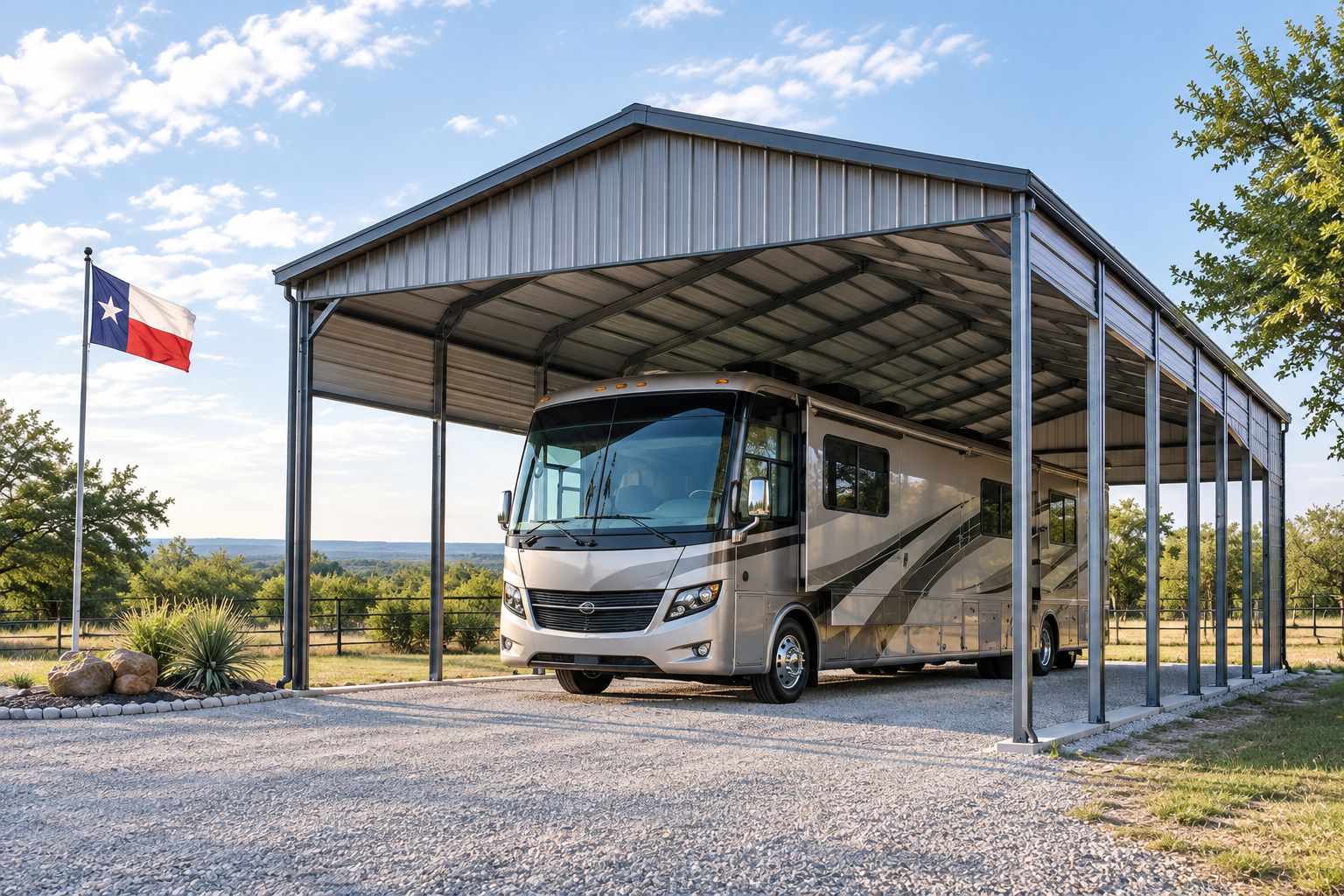
5. 20x30 metal carport: best for RV plus boat or second vehicle storage
Some Texas households don't need more length — they need more width. A 20x30 footprint adds a second bay alongside the RV for a boat, ATV trailer, or a second truck, all under one continuous roof.
20x30 pros:
- One roof over two recreational assets instead of two separate structures
- Fewer roof seams than building two smaller carports side by side
- Works well for families who store more than just the RV
20x30 cons:
- Standard leg height doesn't solve clearance for a full Class A
- Larger footprint draws more county permit scrutiny
- Harder to retrofit onto a narrow existing driveway
20x30 best for: households storing an RV next to a boat or second vehicle. Verdict: Buy for multi-vehicle households. Hold if you only own the RV — a 12x31 does the job for less structure.
6. 24x40+ enclosed metal carport: best for full enclosure and commercial storage
At this size the structure stops being a simple carport and starts functioning as an RV garage — full walls, roll-up doors, and a real foundation instead of piers. This is the size commercial RV storage operators build out in bays.
24x40+ enclosed pros:
- Full walls block hail and UV that fade RV fiberglass and rubber roofing fastest
- Lockable roll-up doors work for leased commercial storage bays
- Adds more resale value to the property than an open-sided structure
24x40+ enclosed cons:
- Highest material and labor cost of any option on this list
- Needs a poured foundation, not gravel or piers
- Permitting runs closer to a standard building than a carport
24x40+ enclosed best for: commercial RV storage lots and owners who want full enclosure. Verdict: Buy for commercial operators. Wait if an open carport already meets your budget and coverage needs.
“If the carport doesn't clear your AC unit by at least a foot, you bought the wrong size.”
How this ranking was built
Each size was scored against the same six criteria: clearance height, roof style, width and length fit for the RV class, wind rating, enclosure option, and permit friction. The 12x31 vertical-roof carport wins overall because it clears the widest range of RV classes — fifth wheels and Class C motorhomes — without stepping into the permitting and cost jump that comes with the 14x36 or the enclosed options.
Sizes that scored well on one dimension but poorly on another dropped in rank even when they looked good on paper. The 20x30, for example, solves width for multi-vehicle households but does nothing extra for RV height, so it never competes with the 14x36 for tall motorhomes.
For buyers weighing roof shapes on their own terms, the full breakdown of metal carport styles covers how vertical, A-frame, and regular roof panels perform against Texas wind and hail beyond just RV coverage.
Which metal carport size should you choose in 2026?
Default to the 12x31 metal carport with a vertical roof unless your RV falls clearly outside its range. Under 21 feet, drop to the 12x21. Over 32 feet or a full Class A, move up to the 14x36. Storing a boat or second vehicle alongside the RV, go with the 20x30. Running a commercial storage lot, the 24x40+ enclosed option is the only one built for that use.
Roof style matters as much as footprint in Texas. A deeper look at how roof shape holds up against wind and hail across all metal building types is in the metal building roof styles comparison.
FAQ
What size carport do I need for a 35 ft RV?
A 35 ft RV needs a 14x36 metal carport with 14 ft legs and a vertical roof. The extra 2 feet of length and height over the 12x31 clears full-size Class A motorhomes and their roof-mounted AC and satellite equipment.
Is a vertical roof better than an A-frame for RV carports in Texas?
Yes, for spans over 26 feet a vertical roof sheds rain and hail faster because the panel ribs run top to bottom instead of side to side. A-frame panels still work fine on shorter carports like the 12x21.
How tall should a metal carport be for a Class A motorhome?
Plan for 14 ft legs on a Class A motorhome. Most full-size units stand close to 13.5 feet tall including roof AC units, so 14 ft legs leave clearance without scraping the crossbeam.
Can a metal carport be enclosed for RV storage?
Yes, a 24x40 or larger footprint can be built with full walls and roll-up doors instead of open sides. This adds hail and UV protection but requires a poured foundation rather than piers.
What wind rating do I need for a metal carport in Texas?
Texas wind zones range from about 90 mph inland to 140 mph along the Gulf Coast. The certified wind rating on the engineering package has to match the zone your county falls into.
How wide should an RV carport be for slide-outs?
A 14 ft wide bay gives room for a partially extended slide-out on a Class A motorhome. Standard 12 ft bays work for travel trailers and fifth wheels without extended slides.
Do I need a permit for a metal RV carport in Texas?
Most Texas counties require a permit once the footprint passes a set square footage, and larger sizes like the 20x30 or 24x40 draw more review than a 12x21. Check with your local building department before ordering.
What's the difference between an RV carport and an RV garage?
An RV carport is open-sided with a roof and legs, while an RV garage or enclosed carport adds full walls and roll-up doors. The enclosed option costs more in materials and needs a real foundation instead of piers.
One last thing
The roof style change from A-frame to vertical panels isn't cosmetic — vertical ribs let rain and hail run straight off the panel instead of pooling in the horizontal seams that A-frame roofs create at longer spans. On anything sized 12x31 or larger, that difference is the reason vertical roof carports show up more often than A-frame ones on Texas RV storage quotes in 2026.